The recital started at 7 PM. You promised you’d be there—front row, flowers in hand, camera ready. But it’s 7:47 PM, and you’re still at your desk, on a “critical” client call that could have been an email. Your assistant texts you a video of your daughter scanning the audience between songs, her smile fading when she doesn’t see you. Again.
This isn’t about being a bad parent. It’s about being trapped in operational bottlenecks of your own making. You’ve been grinding for months—maybe years—and your revenue meter seems permanently stuck somewhere between $750K and $1M, a classic business growth plateau. You’re working harder than ever, pulling 70-hour weeks that would make investment bankers wince, yet the needle barely moves. Meanwhile, you watch competitors who started after you blow past the seven-p mark like it’s a minor speed bump.
Here’s what nobody tells you about the $750K operational ceiling: it’s not a revenue problem. It’s an operational prison designed by your own success. You’ve grown just large enough that informal systems break down, but not large enough to justify the infrastructure you desperately need. You’re trapped in what we call the “Founder’s Paradox”—the harder you work to break through, the more you reinforce the very patterns keeping you stuck, often due to the founder bottleneck.
The truth is, 73% of expert-led businesses hit this invisible business growth plateau between $750K-$1M, and most never escape. But the 27% who do? They don’t work harder. They don’t hire more people. They don’t chase new marketing tactics. They make one fundamental shift that changes everything: they stop being the engine and become the engineer, building a self managing team powered by a robust business operating system.
Why Traditional Growth Tactics Stop Working at the $750K Operational Ceiling
At $750K in revenue, something fundamental breaks in your business—and it’s not what you think. The strategies that got you here become the ceiling preventing you from getting there. Every new client adds complexity. Every new team member needs more management. Every growth attempt creates more operational chaos that only you can solve, highlighting the operational bottlenecks.
The math is brutal and simple. When you’re the founder bottleneck, your business can only grow as fast as you can personally handle more. But you’re already maxed out. You’re making approximately 35,000 decisions per day, from major strategic choices down to approving expense reports. Your brain is literally running out of processing power.
This is why hiring doesn’t help. In fact, it often makes things worse. New team members need training, oversight, and constant guidance—from you. They have questions only you can answer. Problems only you can solve. Standards only you can maintain. Instead of buying you time, each hire costs you time. You’ve accidentally built a business that scales problems faster than it scales revenue, lacking true operational efficiency.
The marketing tactics that worked at $400K fail at $750K because you can’t properly serve more clients without sacrificing quality. The sales strategies that got you here won’t get you there because you’re too busy fulfilling to sell strategically. You’re playing a game where winning actually makes you lose.
The Hidden Cost of Being Your Own Founder Bottleneck
Let’s talk numbers that should terrify you. When you’re stuck at $750K while working 70 hours per week, you’re not just tired—you’re hemorrhaging opportunity. Companies with proper business workflow systems see 40% average annual growth rates. Those without? They plateau at 8% if they’re lucky, but most stay completely flat or decline.
Calculate your real loss: If you’re plateaued at $750K, proper systems would put you at $1.05M next year, $1.47M the year after, and $2.06M by year three. Instead, you’ll likely still be at $750K, except three years more exhausted. That’s $1.31M in lost revenue over three years—not counting the opportunities you missed while drowning in operations.

But revenue is just the tip of the iceberg. Your best employees are secretly job hunting. They joined to make an impact, but everything bottlenecks through you, creating a bottleneck in operations management. They can’t truly own anything. They can’t implement their ideas. They’re playing corporate theater, pretending to have autonomy while waiting for you to tell them what to do. The A-players leave first. The mediocre ones stay, creating a doom loop of declining talent.
Then there’s the personal destruction. Your health is deteriorating from chronic stress. Your relationships are strained from mental absence, even when physically present. You’re missing the life moments you can’t get back—like your daughter’s recital. The cruel irony? You started this business for freedom, but you’ve built the world’s most demanding prison.
The Three Myths Keeping You Stuck
Myth #1: “My business is different—clients want ME specifically.”
Every founder believes they’re irreplaceable. It’s comfortable because it feeds your ego. But here’s the uncomfortable truth: believing you’re irreplaceable isn’t a sign of how valuable you are—it’s evidence of how poorly you’ve built your business, often due to a founder bottleneck. McDonald’s doesn’t need Ray Kroc to make a hamburger. Apple doesn’t need Steve Jobs to sell an iPhone (harsh, but true). Your expertise can be systematized without losing what makes it special.

Daniel thought the same thing. His consulting clients specifically requested him for strategic sessions. He was stuck at $800K for three years, convinced his personal touch was irreplaceable. Six months after implementing the Simple Operations System, a true business operating system, his business hit $2.1M. Today? His company operates at $30M annually, and his clients report HIGHER satisfaction when his team delivers using his systematized frameworks than when he did everything personally.
Myth #2: “I’ve tried systems before—they don’t work for my industry.”
You probably have tried systems. Maybe you implemented EOS and drowned in meetings. Perhaps you hired consultants who left you with fancy frameworks but no real change. Maybe you bought project management software that created more work than it saved. These aren’t systems failures—they’re mismatched solutions. Most business workflow systems are designed for companies with existing infrastructure, not expert-led businesses where the founder IS the system.
The Simple Operations System is different because it’s built specifically for businesses like yours. It doesn’t require departments you don’t have or resources you can’t afford. It works with your existing team and transforms them into a self managing team.
Myth #3: “It’s the market/economy—everyone’s struggling right now.”
While you’re blaming the economy, your competitors are capturing your market share. While you’re waiting for conditions to improve, systematic businesses are thriving. The economy doesn’t care about your excuses. It rewards businesses that can deliver consistently, scale efficiently, and adapt quickly—all things you can’t do when you’re the operational bottleneck.
Here’s proof: during the last economic downturn, businesses using operational systems grew an average of 23% while their unsystematized competitors contracted by 12%. The difference? They could pivot quickly, serve clients efficiently, and capture opportunities while others were drowning in chaos.
The Simple Operations Framework That Changes Everything
What if you could transform from chief everything officer, the ultimate founder bottleneck, to actual CEO? Not absent, but strategic. Not drowning, but directing. This isn’t fantasy—it’s exactly what 400+ founders have achieved using our five-phase transformation system.
Phase 1: Operational Audit (Week 1-2) Map every hour of your week. You’ll discover something shocking: you’re spending 80% of your time on work someone could do for $25/hour. This isn’t judgment—it’s opportunity. Every hour you reclaim from low-value work is an hour for revenue-generating strategy.
Phase 2: System Architecture (Week 3-4) Before delegating chaos, you need to create order. Build your “Operational Armor”—the templates, processes, and frameworks that form your business operating system and let your business run without your constant input. This isn’t about complex documentation. It’s about simple, repeatable systems that maintain your standards automatically.
Phase 3: Authority Transfer (Month 2) Here’s where most founders fail: they delegate tasks but not true ownership. Our Authority Transfer Protocol ensures your team doesn’t just know what to do, but understands the why and how, fostering a self managing team. They learn to think like you without being you.
Phase 4: Rhythm Installation (Month 3) Replace constant interruptions with predictable rhythms. Daily huddles that prevent fires instead of fighting them. Weekly commitments that create accountability without micromanagement. Monthly scorecards that track what matters without drowning in metrics.
Phase 5: Scale Activation (Month 4) Now the magic happens. With operations running smoothly and improved operational efficiency, you focus on growth. Strategic partnerships. Market expansion. Innovation. The high-leverage activities that actually move the revenue needle. Most founders see 20-60% revenue growth in the first year after implementation.
Ready to break through your revenue ceiling once and for all? The complete 5-phase transformation system is detailed in the Passenger Seat Leadership book—including templates, frameworks, and step-by-step instructions. Get your free copy here →
Real Founders Who Shattered Their Operational Ceilings
Sarah’s story might sound familiar. Her consulting firm was stuck at $900K for two years, experiencing a classic business growth plateau. She was working weekends, missing family events, and watching talented employees leave for “better opportunities.” The breaking point came when she lost her biggest client because she couldn’t maintain service quality while trying to grow.
Six months after implementing the Simple Operations System, a comprehensive business operating system, her firm hit $2.8M in revenue. But here’s the remarkable part: she was working 30 hours per week, her team satisfaction scores jumped from 6.2 to 9.1, indicative of a thriving self managing team, and her client retention hit 94%. The business that nearly broke her became the vehicle for the life she’d always wanted.
Or consider Marcus, whose marketing agency hit a business growth plateau at $750K for four straight years. He’d tried everything: new service offerings, aggressive marketing, hiring senior people. Nothing worked because every growth attempt just created more operational complexity, exacerbating the operational bottleneck. Today, his agency runs at $3.2M annually, and he just returned from a three-week vacation where he didn’t check email once. The business grew 8% while he was gone.
These aren’t anomalies. They’re predictable outcomes when you fix the real problem. Our data from 400+ implementations shows that 83.2% of founders achieve complete business confidence after installing proper systems, compared to just 47.7% of those trying to muscle through with willpower alone.
The Decision That Changes Everything
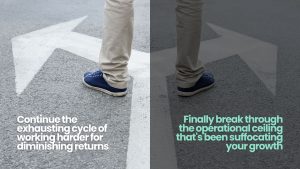
Right now, you’re standing at a crossroads that will define the next five years of your life. You can close this article, return to your overflowing inbox, and continue the exhausting cycle of working harder for diminishing returns. You can keep telling yourself that next quarter will be different, that you just need to push a little harder, hire one more person, or find that perfect marketing tactic.
Or you can make the decision that Daniel, Sarah, Marcus, and 400+ other founders have made: to stop being the engine and become the engineer. To build a business that scales without sacrificing your sanity. To finally break through the operational ceiling that’s been suffocating your growth.
The Simple Operations System isn’t just another business framework. It’s a proven path from operational bottleneck to entrepreneurial freedom. It’s the difference between owning a business and being owned by it. Between growing revenue and growing exhausted. Between building a company and building a cage.
Remember that recital you missed? That’s not just a moment—it’s a symbol of everything this operational chaos is stealing from you. Your daughter won’t remember the revenue you generated that quarter. She’ll remember the empty seat.
But here’s the truth that should terrify you: While you’re reading this, your competitors are implementing these business workflow systems. They’re capturing your market share. They’re hiring your best people. They’re living the life you dreamed of when you started your business.
The Passenger Seat Leadership book contains the complete blueprint for breaking through your revenue ceiling—every framework, template, and step-by-step instruction you need. It’s free because we believe the cost of staying stuck is already too high. But this offer expires soon—we can only support a limited number of founders at once. Download your copy now before it’s too late.
Your 30-Day Quick Start Action Plan
You don’t need to transform everything at once. Here are five specific actions that will start breaking your ceiling immediately:
Week 1: The Revenue Leak Audit Track every task you do for one week. Highlight anything that directly generates revenue in green, everything else in red. You’ll likely discover you spend less than 10% of your time on revenue-generating activities. That’s your opportunity gap.
Week 2: The First System Pick your most repetitive task that takes at least 3 hours weekly. Document it step-by-step, creating a simple business workflow system. Delegate it completely. No takebacks, no “let me just check.” This one action typically frees 15 hours monthly.
Week 3: The Authority Transfer Choose one area where you’re the constant bottleneck. Identify who could own this area with proper support. Create three clear success metrics. Transfer complete authority, including the authority to make mistakes, empowering your self managing team. This is where breakthrough begins.
Week 4: The Growth Focus With your newly reclaimed time, schedule four 2-hour blocks for strategic work only. No operations, no firefighting, no “quick questions.” Use this time for the activities that actually grow revenue: partnerships, innovation, strategic sales.
Each action builds on the last, creating momentum toward your breakthrough. The founders who escape the $750K operational ceiling aren’t more talented or lucky. They just stopped accepting operational chaos as “the price of success” and built something better, focusing on operational efficiency.
The complete 30-day transformation checklist, along with every system, template, and framework you need to break through your revenue ceiling, is waiting in the Passenger Seat Leadership book. Get instant access here and join 400+ founders who’ve already shattered their ceilings.